
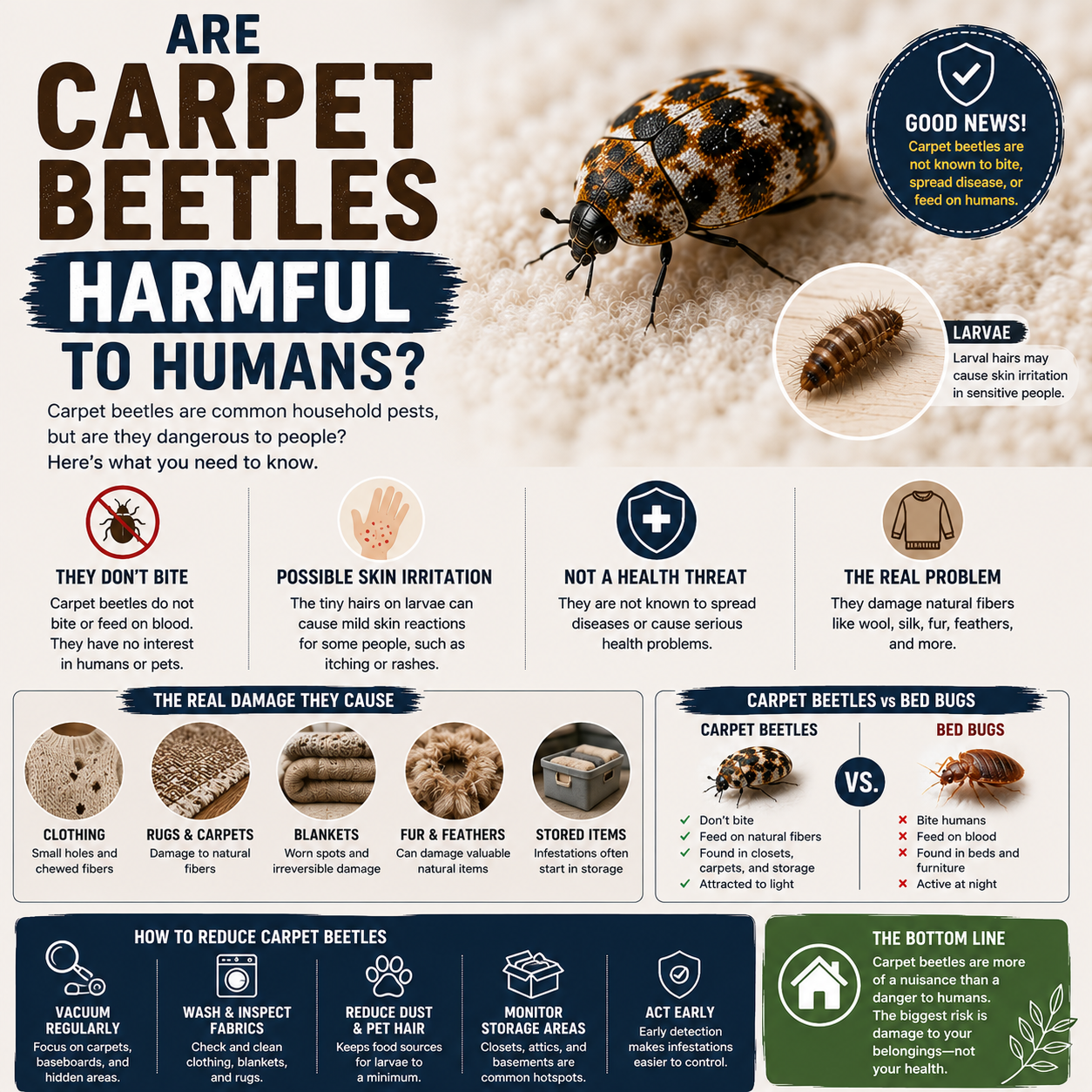
Carpet beetles do not bite, spread disease, or feed on people.
June 17, 2026
4 min read time
This information is reviewed by an independent pest control expert.
All external links are non-affiliated and for informational purposes only
Picture this: you’re vacuuming your living room when you notice a tiny, fuzzy-looking insect near the baseboard.
A few days later, you find another one in a closet.
Then you start searching online and see photos of carpet beetles.
Naturally, a new question comes to mind:
“Are carpet beetles harmful to humans?”
The good news is that carpet beetles are very different from pests like bed bugs, fleas, or mosquitoes.
They don’t feed on blood, they don’t live on people, and they aren’t known for spreading diseases.
However, that doesn’t mean they’re completely harmless.
In this guide, we’ll explain whether carpet beetles pose any risks to humans, what problems they can cause, and when homeowners should be concerned.
Many homeowners first discover carpet beetles after noticing:
Because the insects are often found inside living spaces, it’s natural to wonder whether they can harm people.
Fortunately, carpet beetles are generally considered household nuisance pests rather than dangerous pests.
The main problem is usually property damage—not direct harm to humans.
One of the most common misconceptions is that carpet beetles bite people.
In reality:
Carpet beetles do not bite.
Unlike:
carpet beetles do not feed on blood.
They have no interest in biting humans or pets.
If you’re waking up with bite marks, another pest is likely responsible.
Although carpet beetles don’t bite, some people may experience skin irritation.
This usually happens because of the tiny hairs found on carpet beetle larvae.
In sensitive individuals, contact with these hairs can sometimes cause:
This reaction is sometimes called carpet beetle dermatitis.
Because the rash can resemble insect bites, carpet beetles are occasionally mistaken for bed bugs.
For most people, carpet beetles are not considered a serious health threat.
They are not known to:
Most infestations pose little direct medical risk.
However, individuals with allergies or sensitive skin may experience discomfort if they come into frequent contact with larval hairs.
While they aren’t particularly dangerous to people, carpet beetles can be extremely destructive to household belongings.
Their larvae feed on natural materials such as:
This can lead to damage in:
In many cases, homeowners discover the damage before they ever notice the insects themselves.
These two pests are often confused.
Understanding the difference is important because treatment methods are completely different.
You should take carpet beetles seriously if you notice:
While they may not threaten your health, a growing infestation can become expensive if left untreated.
The best approach focuses on eliminating the conditions that allow them to thrive.
Pay attention to:
Check:
Larvae often feed on accumulated organic debris.
Closets, attics, and basements are common infestation sites.
The sooner an infestation is identified, the easier it is to control.
So, are carpet beetles harmful to humans?
For most people, the answer is:
Not directly.
Carpet beetles do not bite, spread disease, or feed on people.
However, their larvae can occasionally cause skin irritation, and their ability to damage clothing, rugs, and household fabrics can make them a significant nuisance.
The real concern isn’t personal safety—it’s protecting your belongings and preventing a small infestation from becoming a larger problem.
By understanding what carpet beetles can and can’t do, homeowners can respond appropriately and avoid unnecessary panic.