
The answer depends on your needs.
July 27, 2026
14 min read time
This information is reviewed by an independent pest control expert.
All external links are non-affiliated and for informational purposes only
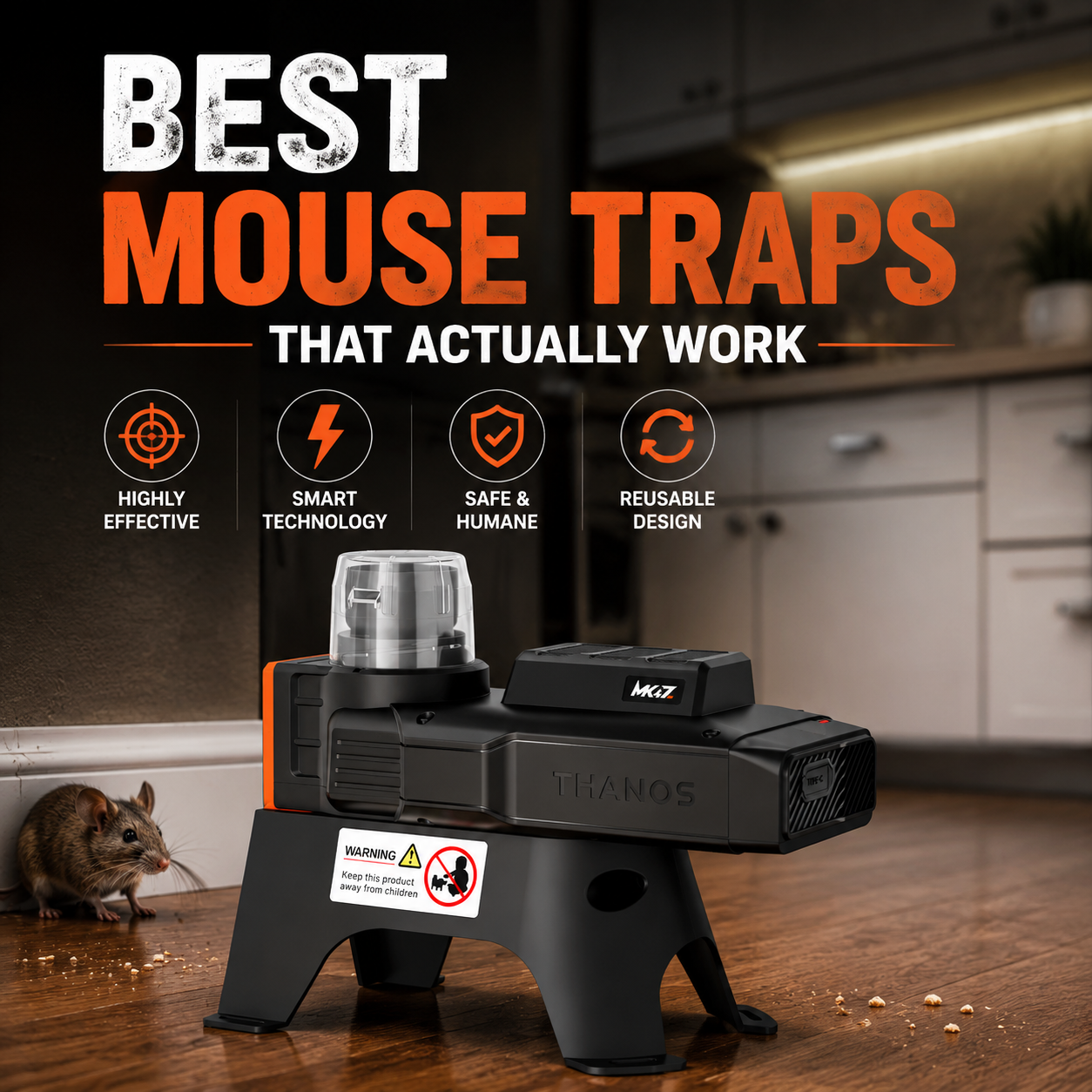
Finding signs of mice in your home can be frustrating. You may hear scratching behind the walls at night, notice droppings near the pantry, or discover food packaging that has been chewed.
Then comes the next question:
What mouse trap should you actually use?
There are more options than ever—traditional snap traps, electronic traps, automatic reusable traps, live-catch traps, and glue traps. Each works differently, and no single trap type is ideal for every home or every mouse problem.
The best choice depends on where the mice are active, how often you’re seeing signs of them, how much maintenance you’re comfortable with, and whether you prefer lethal or non-lethal control.
This guide breaks down the major types of mouse traps, where each makes sense, and what often matters more than simply buying the most powerful-looking trap.
For most homeowners, there isn’t one mouse trap that’s automatically best in every situation.
A better approach is to match the trap to the problem.
| Situation | Trap Type to Consider | Why |
|---|---|---|
| Simple, low-cost mouse control | Snap trap | Inexpensive, widely available, simple mechanism |
| Cleaner indoor disposal | Electronic mouse trap | Enclosed design and less direct contact |
| Recurring rodent activity | Automatic / reusable trap | Reduces repeated manual resetting |
| Non-lethal preference | Live-catch trap | Captures without intentionally killing |
| Activity in several locations | Multiple appropriately placed traps | Covers more active travel routes |
Whatever trap you choose, remember one important point:
A good trap in the wrong location can perform worse than a basic trap placed directly on an active mouse route.
Trap selection matters, but so do placement, bait, food competition, entry points, and regular monitoring.
Before choosing a trap, consider how and where you’re actually dealing with mice.
A trap used behind a refrigerator has different practical requirements from one placed in a garage or storage area.
Look for signs such as:
These signs can help identify the routes mice are already using.
Seeing one mouse doesn’t necessarily mean there’s only one mouse, but the amount and frequency of evidence can help determine how aggressively you should respond.
Occasional signs in one location may be manageable with a few carefully positioned traps.
Repeated activity across several rooms may require multiple traps, closer monitoring, and a stronger focus on finding entry points.
Traditional traps generally need to be inspected and manually reset after an activation.
If you’re placing traps somewhere you don’t visit frequently—or you’re dealing with recurring rodent activity—the amount of maintenance required may become an important consideration.
Some homeowners prefer snap or electronic traps, while others prefer live-catch options.
That preference can narrow your choices quickly.
Whichever method you choose, follow the manufacturer’s instructions and place traps where children, pets, and non-target animals cannot easily access them.
Instead of looking for one universal winner, it can be more useful to choose according to where and how the mouse problem is happening.
Kitchens give mice easy access to crumbs, stored food, water, and hiding places.
An enclosed electronic trap may appeal to homeowners who want less direct contact during disposal.
Traditional snap traps can also work, particularly when placed correctly behind appliances, along cabinets, or near established travel routes.
The biggest challenge in a kitchen is often competing food.
If mice can easily access crumbs, pet food, cereal, or other food sources, they may have less reason to investigate your bait.
Garages often contain multiple potential entry points, stored materials, clutter, and long wall edges that mice can follow.
For occasional activity, snap or electronic traps may be sufficient.
For recurring activity, homeowners may consider multiple traps or an automatic/reusable system, especially when frequent manual resetting becomes inconvenient.
Placement is particularly important around garage doors, storage areas, wall edges, and other locations showing rodent activity.
Basements often provide mice with quiet areas and access through utility penetrations, pipes, foundation gaps, and storage spaces.
Snap traps and electronic traps can both be useful depending on the environment.
Focus on:
Don’t scatter traps randomly throughout an open basement if you already know where the mice are traveling.
If you’ve only noticed limited activity, you may not need a complicated trapping system.
A few properly positioned snap or electronic traps may be enough.
However, continue checking for droppings and other evidence even after activity stops.
The mouse you saw may not be the only one using the area.
Repeated activity changes the equation.
If you’re constantly checking and resetting individual traps, automatic or reusable trapping systems may become more practical.
You should also investigate why mice continue entering the property.
Trapping without addressing entry points can turn into an endless cycle of catching mice while new ones continue getting inside.
An enclosed electronic trap can make disposal more convenient for homeowners who prefer not to handle an exposed conventional trap.
Always follow the manufacturer’s instructions when checking, cleaning, or resetting the device.
For homeowners who prefer non-lethal control, live-catch traps are the main alternative.
They require frequent monitoring because an animal should not be left confined unnecessarily.
Also consider that capturing a mouse does not solve the original entry problem. If access points remain open, additional mice may continue entering.
Now let’s look more closely at the major trap designs.
Snap traps are among the most familiar mouse-control tools.
They use a spring-loaded mechanism that activates when the mouse interacts with the trigger.
Snap traps can be very effective when used correctly, but more spring force doesn’t automatically mean better mouse control.
If you’re specifically interested in how trap power, trigger reliability, and mechanism strength compare, see:
What Is the Strongest Mouse Trap? Real-World Results Compared
Electronic mouse traps use an electrical mechanism rather than a spring-loaded snapping bar.
Many designs place the operating area inside an enclosed chamber.
Electronic traps can be a good option for kitchens, garages, storage rooms, and other indoor spaces where an enclosed design is preferred.
If you want to see one example, you can view the Thanos Electronic Mouse Trap here.
Automatic traps address a different problem: repeated manual resetting.
Instead of judging these traps only by how “powerful” the mechanism is, it makes more sense to consider how they operate over repeated rodent activity.
One example is the Thanos MK47 Rodent Trap.
The MK47 is designed around automatic resetting and rechargeable operation. According to its product specifications, it provides:
The advantage here isn’t that an automatic trap should automatically be called “stronger” than every other trap.
It’s the ability to reduce repeated manual resetting.
That can be particularly useful in garages, storage spaces, warehouses, and other areas where rodent activity may continue over time.
As with every other trap type, correct placement still matters.
Live-catch traps capture mice without intentionally killing them.
If you use live traps, check them frequently and review any applicable local wildlife regulations before relocating an animal.
Glue boards capture rodents using an adhesive surface.
They’re inexpensive and widely available, but they come with significant animal-welfare concerns because captured rodents may remain alive and restrained.
They can also catch non-target animals if used carelessly.
For homeowners comparing long-term mouse-control options, snap, electronic, automatic, and live-catch traps generally provide clearer mechanisms for active trapping.
Here’s a simplified overview:
| Trap Type | Main Advantage | Main Limitation | Best Suited For |
|---|---|---|---|
| Snap | Simple and inexpensive | Manual reset and exposed mechanism | Basic household trapping |
| Electronic | Enclosed operation | Requires power | Indoor areas and easier disposal |
| Automatic / Reusable | Reduced repeated resetting | Higher initial cost | Recurring rodent activity |
| Live Catch | Non-lethal capture | Requires frequent monitoring | Non-lethal preference |
| Glue | Low initial cost | Welfare and non-target concerns | Limited monitoring applications |
This table is intentionally simplified.
If you want a more detailed comparison of trap types and their trade-offs, read:
Best Mouse Trap Comparison: Snap vs Electric vs Humane Traps
Trap placement can be just as important as trap selection.
Mice commonly move along protected edges rather than crossing exposed areas unnecessarily.
Good places to investigate include:
For conventional snap traps positioned along a wall, a common approach is to place the trigger or baited end toward the wall.
Avoid placing every trap in the center of an open room simply because there’s available space there.
If you want the full placement and setup process, see:
How to Set a Mouse Trap Properly: Placement, Bait, and Setup Tips That Actually Work
One of the most common mistakes is using a single trap when mice are active across a much larger area.
There isn’t one number that works for every house.
The better question is:
How many active travel routes are you trying to cover?
If you’re finding droppings behind the refrigerator, beside the pantry, and along a garage wall, one trap in the kitchen may leave other active routes completely uncovered.
Multiple strategically placed traps can also give you useful information about where activity is concentrated.
Even a good mouse trap can perform poorly when the surrounding setup is wrong.
One trap covers one small area.
If mice are active in several locations, use enough traps to cover the routes where you’re actually seeing evidence.
A trap several feet away from an active mouse route may never be investigated.
Follow the evidence instead of placing traps where they’re easiest for you to see.
A baited trap has to compete with everything else available.
Clean up crumbs, secure pantry food, avoid leaving pet food accessible overnight, and address garbage or other easy food sources.
Check traps according to the manufacturer’s instructions and reset, recharge, clean, or replace them when necessary.
More bait isn’t necessarily better.
Large amounts of loose bait can sometimes make it easier for a mouse to take food without interacting correctly with the trigger.
A small amount placed on the intended bait or trigger area is often more useful.
If bait disappears but the trap doesn’t activate, don’t immediately assume you need a more powerful trap.
Check:
Activation reliability often matters more than raw power.
Peanut butter is popular because it’s aromatic and can be applied in a small amount to a trigger area.
But mice can investigate many foods depending on what’s already available in the environment.
Other options people commonly try include:
The important point isn’t necessarily finding a magical bait.
If mice are already feeding heavily on something in your kitchen or garage, removing competing food and positioning the trap on their travel route may matter more than constantly changing bait.
Trapping addresses mice that are already active.
Exclusion helps address how new mice are getting inside.
After trapping, inspect the property for possible access points around:
Also reduce food and shelter opportunities by keeping food sealed, cleaning crumbs, organizing clutter, and managing accessible pet food.
The long-term goal isn’t simply to keep trapping mice.
It’s to reduce the conditions that allow mice to enter and remain in the first place.
It depends on the situation. Snap traps are simple and inexpensive, electronic traps provide an enclosed design, automatic/reusable traps reduce repeated resetting, and live-catch traps provide a non-lethal option.
Correct placement and setup are important regardless of trap type.
Not automatically.
Electric and snap traps use different mechanisms and have different advantages. Electronic traps may appeal to homeowners who prefer an enclosed design, while snap traps are inexpensive and easy to deploy in larger numbers.
Choose based on your environment and maintenance preferences rather than assuming one technology is universally better.
Use enough traps to cover the areas where you’re seeing actual activity.
A home with signs in several rooms will generally require a different strategy from a home with one localized travel route.
Focus on active travel routes such as walls, baseboards, behind appliances, pantry edges, garages, and areas near droppings or gnaw marks.
Avoid relying on random placement in open spaces.
Possible reasons include poor placement, competing food, unfamiliar objects, inappropriate bait, excessive disturbance, or the trap being outside the mouse’s normal travel route.
Before replacing every trap, verify that you’re placing them where mice are actually moving.
Yes.
This can happen when too much bait is used, the bait isn’t positioned correctly on the trigger, or the mouse can reach the food without interacting with the activation area as intended.
Adjusting the setup may solve the problem without changing trap types.
There isn’t one mouse trap that’s automatically best for every homeowner.
If you want simple and inexpensive control, a snap trap may make sense.
If you prefer an enclosed indoor design, consider an electronic mouse trap.
If you’re dealing with recurring rodent activity and want to reduce repeated manual resetting, an automatic/reusable trap may be worth considering.
If you prefer non-lethal capture, a live-catch trap is the relevant category.
But don’t focus so much on choosing the “best” trap that you overlook the basics.
Correct placement, enough traps, limited competing food, proper setup, regular monitoring, and sealing entry points can matter just as much as the trap itself.
The goal isn’t simply to buy the strongest or most expensive mouse trap.
It’s to choose the right trapping method for your situation—and use it where the mice are actually active.