
The answer depends on the size of the infestation, where the beetles are hiding, and how thoroughly the treatment is applied.
July 23, 2026
5 min read time
This information is reviewed by an independent pest control expert.
All external links are non-affiliated and for informational purposes only
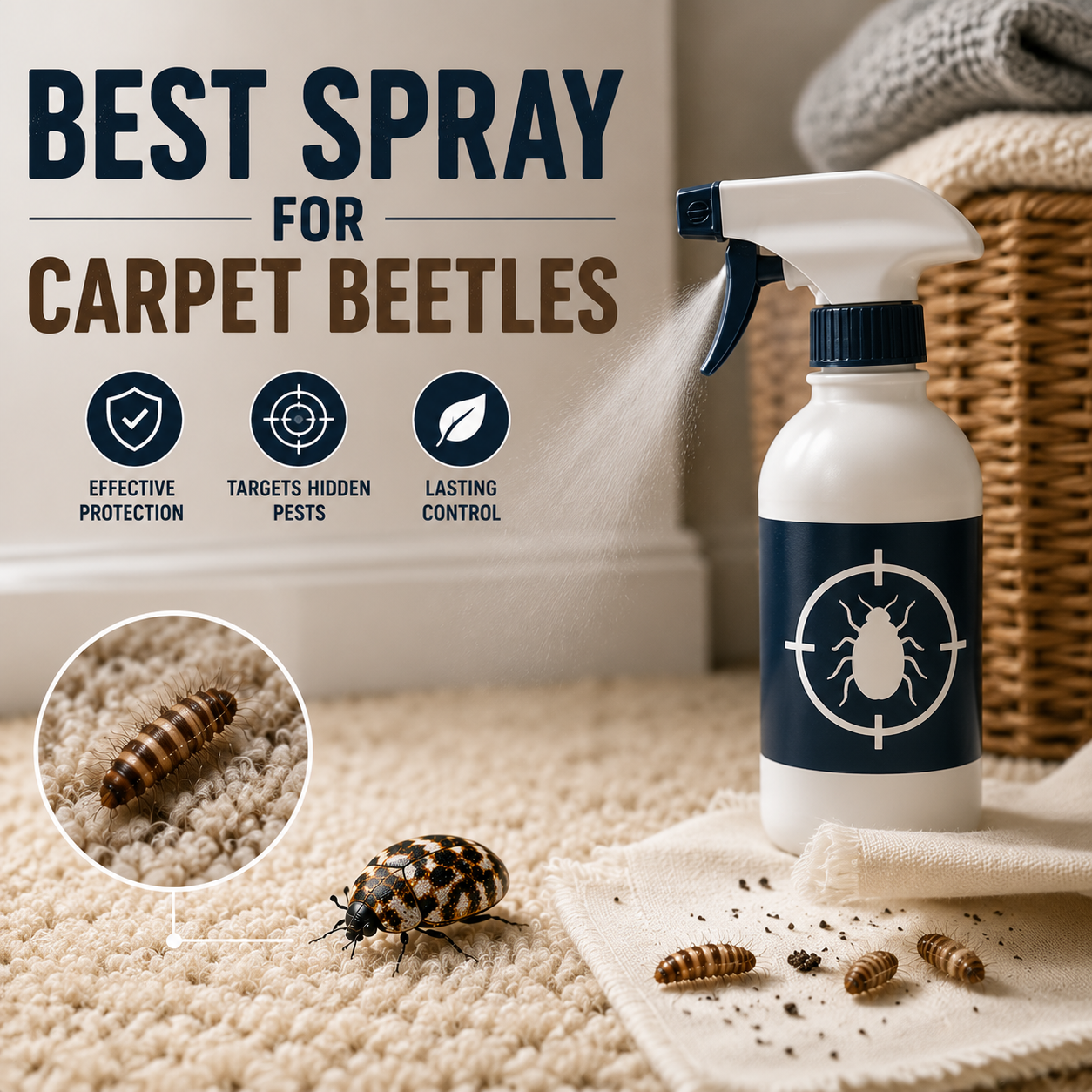
You discover carpet beetle larvae near your baseboards or notice damage appearing on your favorite fabrics.
Your first thought is probably simple:
“What spray can I use to get rid of them quickly?”
A quick search online reveals dozens of products claiming to be the “best carpet beetle spray.” But with so many options available, it can be difficult to know what actually works—and whether spraying alone is enough.
The truth is that carpet beetle control is not just about killing the insects you see. Since larvae often hide in carpets, closets, and other hard-to-reach areas, choosing the right approach matters.
In this guide, we’ll explain what makes a carpet beetle spray effective, what ingredients to look for, how sprays fit into a complete treatment plan, and why some infestations return even after spraying.
Carpet beetles are small, but they can cause significant damage inside homes.
The main problem is not usually the adult beetles—it’s the larvae.
Carpet beetle larvae hide and feed in places such as:
Because they spend much of their time hidden, simply spraying visible insects may not eliminate the entire infestation.
The best spray is one that helps target the areas where carpet beetle larvae actually live.
A good carpet beetle spray should help address several challenges:
Some treatments continue working after application, helping control insects that come into contact with treated surfaces later.
Carpet beetles often hide in:
A spray that can reach these areas is usually more useful.
Because carpet beetles are commonly found indoors, homeowners should choose products designed specifically for household environments and always follow label instructions.
There are several types of sprays homeowners commonly use.
These are convenient options for smaller problems.
Advantages:
Common uses include:
These require mixing before use.
Advantages:
However, they require careful preparation and proper application.
Some homeowners prefer botanical-based options.
Common ingredients include:
These may be preferred by people looking for lower-chemical alternatives, although effectiveness can vary depending on the situation.
Different products use different active ingredients.
Common categories include:
Often used in household insect control products.
They are designed to affect insects that come into contact with treated surfaces.
Some treatments focus on disrupting insect development.
These can be useful because carpet beetles have multiple life stages.
Plant-based formulas may include natural compounds designed to repel or control insects.
The most important factor is not just the ingredient—it is whether the product is used correctly and applied to the right areas.
Spraying randomly throughout the home is usually less effective.
Focus on areas where carpet beetles are likely to hide:
A common travel area for larvae.
Especially where:
are kept.
Dust and pet hair often accumulate here.
Especially along edges and underneath furniture.
Including:
Many homeowners are disappointed because carpet beetles return after spraying.
This usually happens because:
Sprays may not eliminate all eggs already present.
Larvae may be deeper inside:
If larvae still have access to:
they can continue developing.
Adult carpet beetles can enter homes through:
Adults are not usually responsible for fabric damage.
The larvae are the main concern.
Spray works better when combined with:
Carpet beetles can spread between:
More spray does not always mean better results.
Always follow product instructions.
For better long-term control:
Focus on:
Clean:
Use sealed containers for seasonal fabrics.
Continue checking for:
So, what is the best spray for carpet beetles?
The answer depends on the size of the infestation, where the beetles are hiding, and how thoroughly the treatment is applied.
A quality spray can be an important tool—but it is rarely the only step needed.
The most effective approach combines:
Because with carpet beetles, success comes from breaking the infestation cycle—not just eliminating the insects you can see.