
The most important step is understanding the scope of the problem before deciding on a treatment approach.
May 25, 2026
4 min read time
This information is reviewed by an independent pest control expert.
All external links are non-affiliated and for informational purposes only
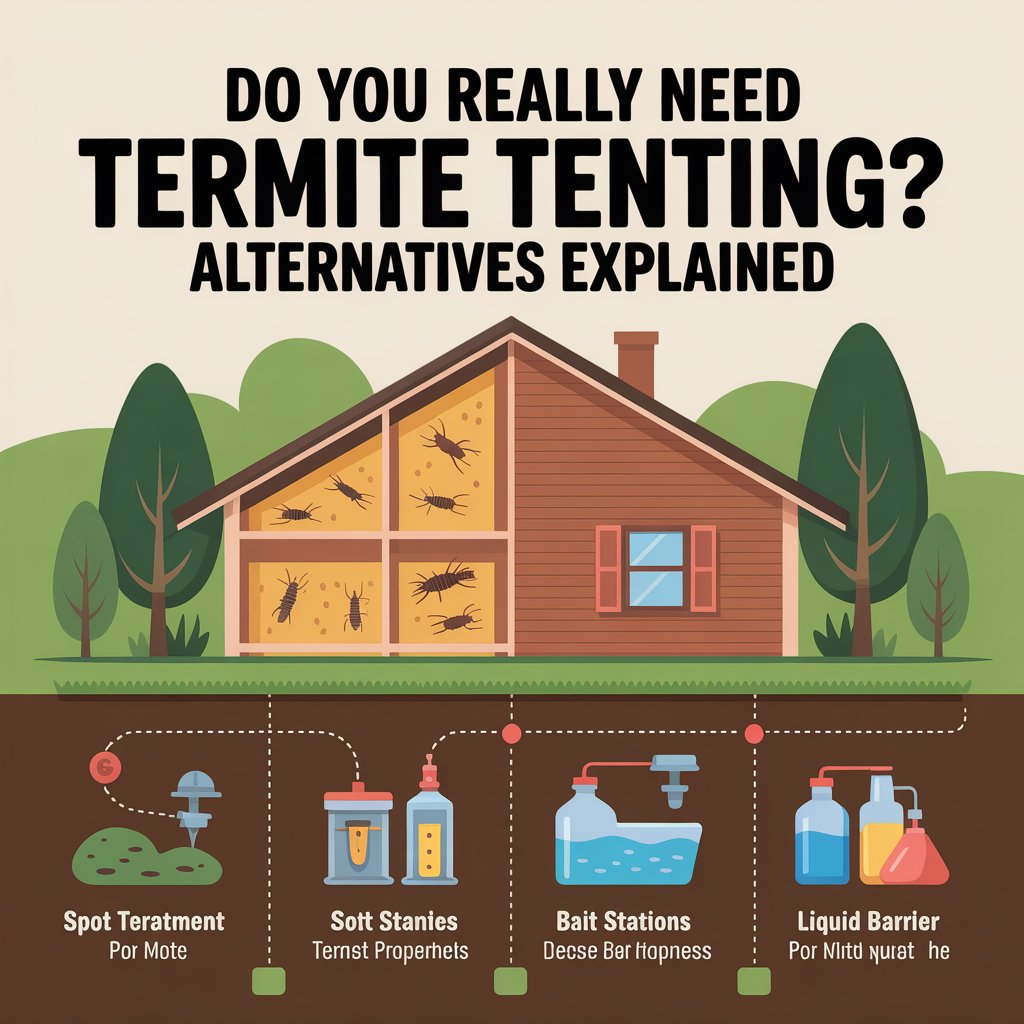
After a termite inspection, you’re told your home may need tenting.
Suddenly, what started as a pest problem feels much bigger.
You start imagining:
And naturally, the question comes up almost immediately:
Do I really need termite tenting—or are there other options?
The answer depends on the type of termites, the extent of the infestation, and where the activity is located.
In this guide, we’ll break down when termite tenting is actually necessary, what alternatives exist, and why not every termite problem automatically requires full fumigation.
Few pest control recommendations sound as overwhelming as termite tenting.
Unlike many treatments, tenting affects the entire home.
It often involves:
That’s why many homeowners immediately look for alternatives—and in some cases, alternatives may actually be appropriate.
Termite tenting, also known as structural fumigation, involves enclosing the home and introducing fumigants designed to eliminate termites throughout the structure.
It is most commonly used for:
Because the fumigant penetrates throughout the structure, tenting is often considered one of the most comprehensive treatment methods. (orkin.com)
Professional pest control companies may recommend tenting when:
Drywood termites are especially challenging because they live entirely inside wood and don’t require contact with soil. (terminix.com)
In these cases, localized treatments may not fully eliminate the problem.
Not every termite issue automatically requires tenting.
Alternatives may be considered when:
The key factor is whether the infestation can realistically be contained and treated directly.
Several alternative approaches may be used depending on the situation.
These treatments target specific affected areas instead of the entire structure.
They are sometimes used when:
However, missed activity can remain hidden elsewhere.
Certain products can be injected into wood or wall voids where termite activity is present.
These methods are more targeted but rely heavily on accurate identification of infestation areas.
Some companies use controlled heat to eliminate termites in localized areas.
This approach may avoid chemical fumigation but is not suitable for every situation.
For subterranean termites, bait systems and monitoring stations may help control activity over time. (epa.gov)
These systems are more focused on long-term management and prevention.
There are several reasons homeowners hesitate when tenting is recommended.
Common concerns include:
These concerns are understandable—especially for large homes or families with pets and children.
Some infestations can be treated locally, depending on the severity and species involved.
Localized methods may fail if hidden termite activity is missed.
Fumigation eliminates current infestations but does not prevent new termites from returning later.
Ongoing prevention and monitoring are still important.
Termite tenting can sound intimidating—but it’s not always automatically necessary.
The right treatment depends on:
In some cases, localized alternatives may be enough. In others, tenting may be the most reliable way to fully eliminate hidden activity.
The most important step is understanding the scope of the problem before deciding on a treatment approach.