
By combining thorough cleaning, fabric treatment, and ongoing monitoring, most homeowners can significantly reduce carpet beetle activity and prevent future infestations.
June 9, 2026
4 min read time
This information is reviewed by an independent pest control expert.
All external links are non-affiliated and for informational purposes only
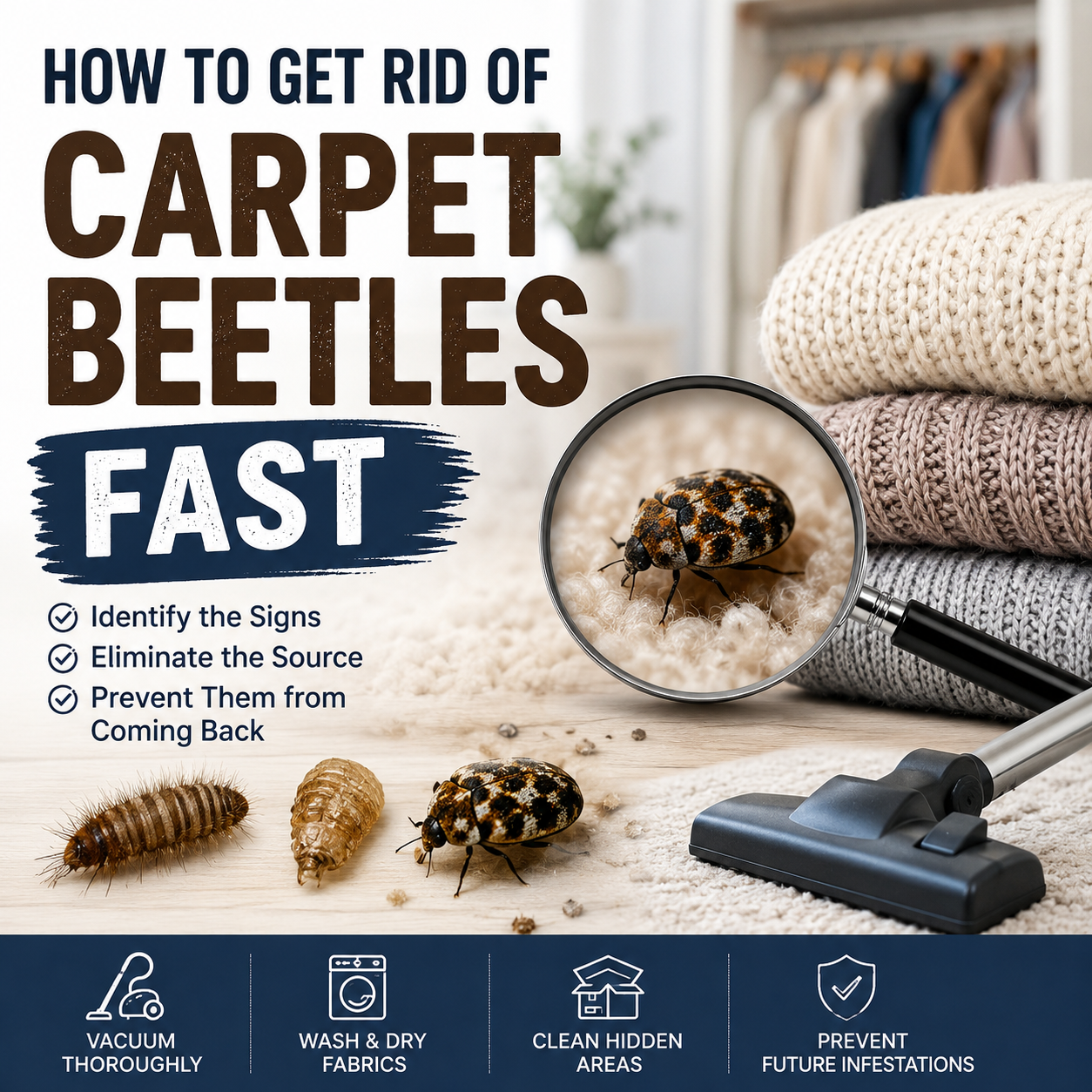
You’re putting away laundry when you notice a small hole in a sweater.
At first, you don’t think much of it. Maybe it snagged on something.
But then you find another hole in a blanket. And another in a stored jacket.
A few days later, you spot a tiny, fuzzy-looking insect crawling along a baseboard.
Now you’re asking yourself:
How long has this been happening—and how do I get rid of carpet beetles fast?
The good news is that carpet beetles can be controlled. The challenge is that many homeowners only treat the visible signs while missing the source of the problem.
In this guide, we’ll explain how carpet beetle infestations develop, why they can be difficult to eliminate, and the fastest way to get them under control.
Unlike some pests that are immediately obvious, carpet beetles often remain hidden for weeks—or even months.
By the time you notice the damage, the infestation may already be well established.
What makes them especially frustrating is that:
As a result, many homeowners spend time treating the wrong issue while the infestation continues to grow.
To get rid of carpet beetles quickly, it helps to understand what you’re actually fighting.
The larvae feed on:
This means they don’t just survive on clothing—they can also thrive on materials that accumulate naturally around the home.
Because food sources are often hidden, infestations can continue even after visible fabrics have been cleaned.
Before starting treatment, it’s important to confirm the problem.
Common signs include:
Damage often appears in:
You may find:
Carpet beetle larvae are:
They are often found in dark, undisturbed areas.
Adult carpet beetles are attracted to light.
It’s common to spot them:
The fastest approach focuses on both the insects and the conditions that allow them to survive.
Vacuum:
Pay special attention to edges and corners where debris tends to collect.
Clean items such as:
Hot washing and drying can help eliminate larvae and eggs hiding in fabrics.
This is one of the most important steps.
Look for:
Without removing these sources, carpet beetles often return.
Check:
Many infestations begin in areas that are rarely disturbed.
Even after cleaning, continue checking for:
Monitoring helps ensure the infestation is truly under control.
One of the most common frustrations homeowners face is seeing carpet beetles return after treatment.
This usually happens because:
In many cases, the problem wasn’t solved—it was simply interrupted.
Larvae often hide where people rarely look.
The adults aren’t responsible for the damage.
The larvae are the real issue.
Closets and stored fabrics are common infestation sites.
Many homeowners stop cleaning once activity decreases, allowing the infestation to rebuild later.
Once the problem is under control, prevention becomes much easier.
Helpful habits include:
Small preventive steps often make a significant difference.
Carpet beetles may be small, but they can cause surprisingly expensive damage if ignored.
The fastest way to get rid of them isn’t simply killing the insects you can see—it’s removing the conditions that allow them to survive.
By combining thorough cleaning, fabric treatment, and ongoing monitoring, most homeowners can significantly reduce carpet beetle activity and prevent future infestations.
Because when it comes to carpet beetles, speed matters—but thoroughness matters even more.