
Early Detection Makes a Difference
June 16, 2026
4 min read time
This information is reviewed by an independent pest control expert.
All external links are non-affiliated and for informational purposes only
You’re pulling a favorite sweater out of storage when you notice a small hole near the sleeve.
At first, it doesn’t seem like a big deal. Maybe it snagged on something.
A few days later, you discover similar damage on a blanket. Then you find tiny shed skins near a baseboard.
Suddenly, what seemed like random wear and tear starts looking like something else entirely.
That’s often how carpet beetle infestations begin—not with large numbers of visible insects, but with subtle signs that are easy to overlook.
In this guide, we’ll explore the most common signs of a carpet beetle infestation, how to recognize them early, and why catching the problem quickly can help prevent costly damage.
Unlike cockroaches or ants, carpet beetles rarely announce their presence.
Many homeowners don’t realize they have an infestation until damage has already occurred.
That’s because:
Understanding what to look for can help you identify a problem before it spreads.
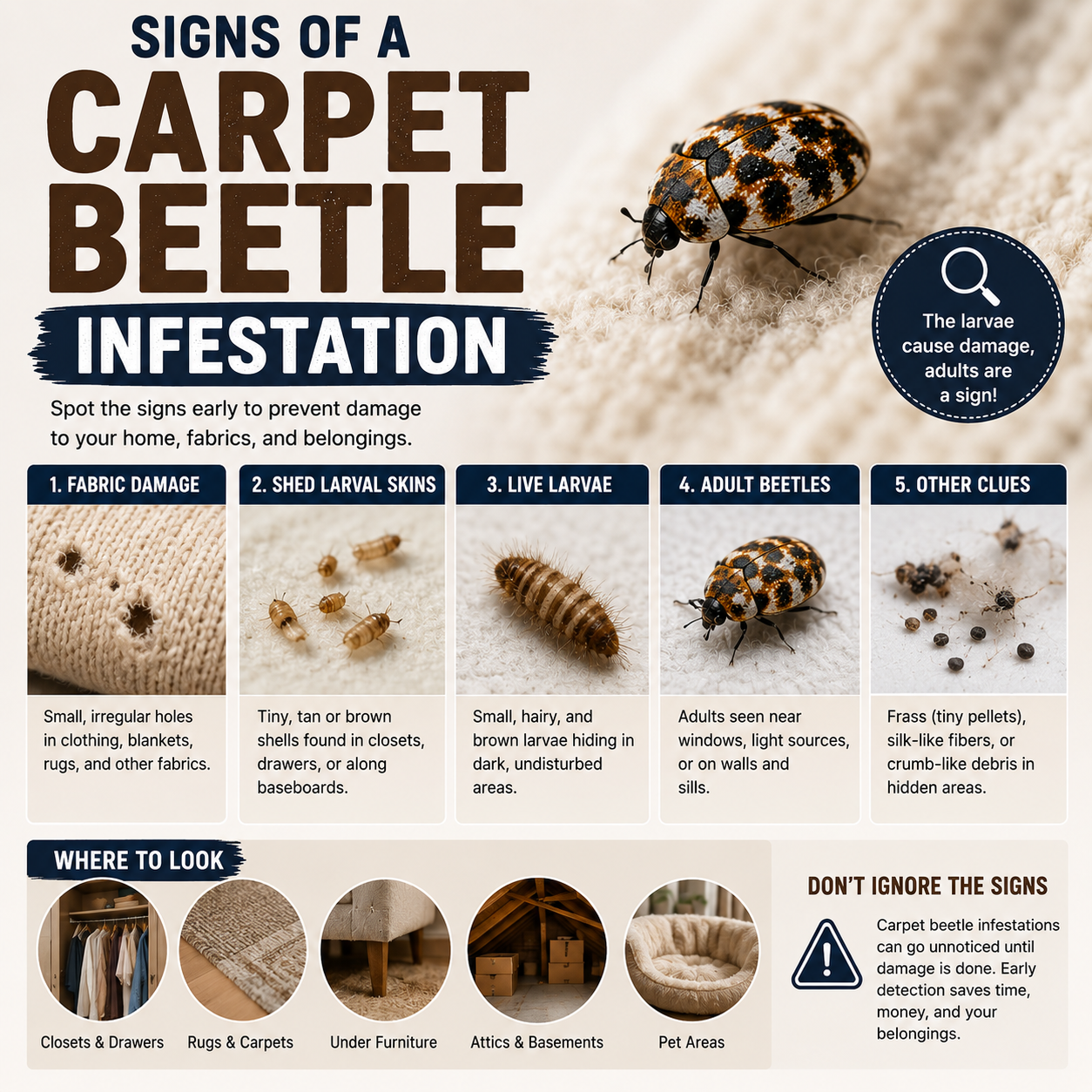
One of the most common signs of carpet beetles is unexplained damage to fabrics.
You may notice:
Unlike moth damage, carpet beetle damage often appears in scattered areas rather than uniform patterns.
Natural materials are especially vulnerable, including:
The larvae are responsible for nearly all carpet beetle damage.
Common signs include:
As larvae grow, they shed their outer skins.
You may find:
These are often one of the earliest indicators of an active infestation.
Carpet beetle larvae are typically:
They often move slowly and prefer dark, undisturbed locations.
Adult carpet beetles look very different from the larvae.
Depending on the species, they may appear:
Homeowners frequently notice them:
While adults don’t cause fabric damage, their presence often signals that eggs may be nearby.
Carpet beetles prefer quiet areas that are rarely disturbed.
Common hotspots include:
Stored clothing and fabrics provide ideal feeding conditions.
Dust, lint, and pet hair often accumulate in these spaces.
Long-term storage makes these areas especially attractive.
Larvae frequently travel along edges and hidden gaps.
Pet hair and dander can provide a valuable food source.
In addition to fabric damage, watch for:
These clues often appear before major damage becomes obvious.
Carpet beetle infestations are frequently confused with other pest problems.
Both damage fabrics, but carpet beetle larvae often leave behind shed skins and bristly hairs.
Bed bugs cause bites.
Carpet beetles damage materials and generally do not feed on people.
Many homeowners assume damaged fabrics are simply old or worn until the problem becomes widespread.
If you suspect carpet beetles:
Check:
Finding larvae often confirms active infestation.
Focus on:
Repeated sightings usually indicate a larger underlying problem.
Carpet beetle infestations often begin quietly, but the damage can become significant if left unchecked.
The most common warning signs include:
The sooner you recognize these signs, the easier it becomes to control the infestation and prevent further damage.
Because with carpet beetles, waiting for obvious evidence often means the problem has already been growing for some time.